1963 Chevrolet C2 Corvette Sting Ray
.jpg/:/rs=w:400,cg:true,m)
Price - £81,995
Year - 1963
Triple-Black specification
327/300 V8
Four-Speed Muncie Manual
Exceptional Transatlantic Provenance
NCRS Top Flight
Few examples of the original Corvette Sting Ray can claim a history quite as remarkable as this beautifully presented 1963 Convertible.
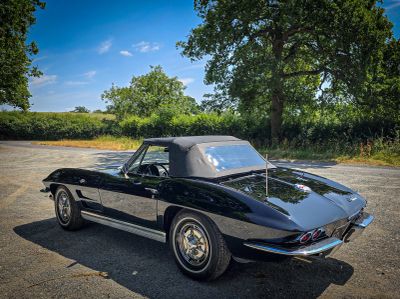
Finished in striking Tuxedo Black with a black interior and matching convertible hood, chassis 30867S118083 combines one of America's most celebrated sports car designs with an extraordinary transatlantic history.
Completed at Chevrolet's St Louis assembly plant in June 1963, the Corvette passed through American ownership before entering the collection of renowned luxury watchmaker and motorsport enthusiast Philippe Charriol in 1990.
Its subsequent years in France included extensive mechanical maintenance and a fascinating competition-related chapter, during which the car was modified into a Grand Sport-inspired coupé.
Returning to Britain as a dismantled project, it was acquired in 2016 by respected Corvette specialist Tom Falconer of Claremont Corvette, who oversaw a painstaking programme of reconstruction and restoration to its original convertible configuration.
The restoration culminated in the award of NCRS Top Flight status in September 2021, achieving 94.3%, following earlier Third Flight and Second Flight assessments.
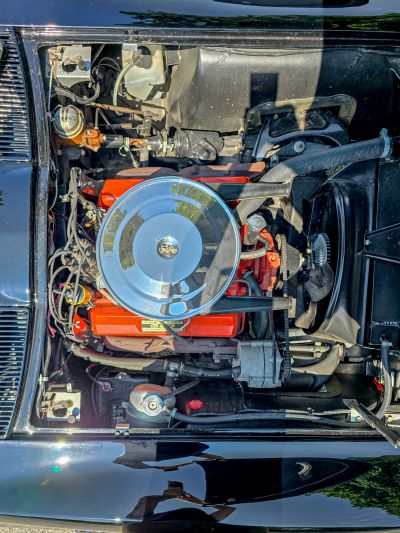
Powered today by a professionally rebuilt, correct-specification 327ci/300hp V8 with a period Muncie four-speed manual gearbox, the Corvette has subsequently benefited from further cosmetic refinement, including a complete repaint.
Accompanied by an extensive historical archive spanning the United States, France and Britain, this is a particularly compelling first-year Sting Ray for the enthusiast or collector who values provenance, restoration quality and individuality.
The Birth of the Sting Ray
The arrival of the second-generation Corvette for the 1963 model year marked a defining moment in Chevrolet's history. Although the first-generation Corvette had established the model as America's sports car, the new Sting Ray transformed it into a machine capable of competing with Europe's finest in both engineering and design.
Developed under the direction of General Motors styling chief Bill Mitchell, with Larry Shinoda responsible for much of its distinctive appearance, the new Corvette abandoned the rounded lines of its predecessor in favour of a sharper, more purposeful form inspired by contemporary competition cars. Hidden headlamps, crisply sculptured wings and a dramatically tapered bonnet combined to create one of the most recognisable sports car designs of the twentieth century.
Beneath the dramatic styling lay equally significant mechanical advances. The new chassis incorporated fully independent rear suspension for the first time, improving both ride quality and handling, while Chevrolet's proven small-block V8 provided effortless performance across a range of outputs.
Today, the 1963 model occupies a unique position within Corvette history. It represents both the beginning of the celebrated C2 generation and the moment when the Corvette matured into a genuinely world-class sports car.
Documented American Origins
The accompanying NCRS Shipping Data Report confirms that chassis 30867S118083 was completed at Chevrolet's St Louis, Missouri, assembly plant on 24 June 1963 before being dispatched to Smart Chevrolet of Pine Bluff, Arkansas, its original supplying dealer.
By the late 1980s it was owned by June D. Spier of Sag Harbor, New York, by which time it had been refinished in red. On 25 April 1990 ownership passed to Philippe Charriol, then resident in Hampton Bays, New York, beginning what would become one of the most significant periods in the car's history.

.jpg/:/rs=w:400,cg:true,m)
Philippe Charriol and the French Connection
Philippe Charriol was far more than a successful businessman. Internationally recognised for the luxury watch and jewellery brand that bore his name, he was also an accomplished collector, enthusiast and racing driver whose interest in high-performance machinery extended well beyond road cars.
With an ownership spanning 17 years the archive accompanying this Corvette contains New York and New Jersey registration and insurance documents in Charriol's name, together with period photographs, biographical material and images of several of his competition cars. Collectively, they provide unusually strong documentary evidence linking one of the Corvette's most notable custodians to the car itself.
Ownership was formally transferred within the Charriol family during 1995 before the Corvette was imported into France in January 1996. Having completed the required homologation and technical inspection process, it was registered for French road use as 4444 TE 13, beginning a lengthy period of documented use on the Continent.
Stewardship Rather Than Storage
One of the most revealing aspects of the French history is the extent to which the Corvette continued to be maintained and improved rather than simply preserved.
Shortly after its arrival in France, the car underwent significant recommissioning work, while workshop invoices and handwritten engineering notes record an extensive programme of mechanical maintenance throughout the period. Particularly telling is the repeated fabrication of components where replacement parts were unavailable, reflecting a determination to maintain the car properly rather than simply keep it operational by expedient means.
During its later years in France, the Corvette also became associated with classic circuit activity, and it is believed that Philippe Charriol raced the car at various French circuits.
Importantly, while the documentation supports this competition-related chapter, it does not establish a complete record of individual race entries or results. Accordingly, the Corvette is presented exactly as the surviving evidence supports: a car that demonstrably formed part of Charriol's wider motorsport interests without relying upon claims that cannot be substantiated.
At some stage during or after this period, it is understood the original convertible body was altered into a Grand Sport-inspired competition-style coupé incorporating a one-piece front section, widened wheelarches and other race-inspired modifications.
The Charriol family is understood to have sold the Corvette in 2007; 17 years after the initial purchase by Philippe himself. By the time it eventually resurfaced in Britain, it had been dismantled and resided with a gentleman in Nottinghamshire.
Recovery in Britain
The Corvette's next chapter began in January 2016, when respected Corvette authority, author, Claremont Corvette founder and long-standing NCRS member Tom Falconer acquired the dismantled project.
Imported from France among a substantial collection of Chevrolet parts and competition components, the Corvette presented in far from ideal condition. Nevertheless, Falconer recognised the significance of what remained. The chassis retained its identity, many original components survived and, perhaps most importantly, the accompanying record of the car's history. Rather than representing an anonymous restoration project, it was a Corvette whose history could be followed with unusual continuity.
An HMRC NOVA declaration submitted through Claremont Motorsport on 18 March 2016 formally recorded the Corvette's arrival in the United Kingdom, identifying chassis 30867S118083. What followed was not a cosmetic restoration, but a comprehensive reconstruction intended to return the Corvette to its original 1963 convertible specification while achieving a standard capable of meeting the demanding requirements of NCRS judging.
Returning to Its Original Form
Replacement body panels, valued at almost US $5,000, were sourced directly from American Custom Industries in Ohio, one of the leading suppliers of Corvette fibreglass components. Rather than disguising the Corvette's earlier history, the restoration sought to reverse it with accuracy, returning the car to the configuration in which it left St Louis during the summer of 1963.
.jpg/:/rs=w:400,cg:true,m)
More Than Five Hundred Hours of Reconstruction
The extent of the restoration is perhaps best illustrated by the records from Motivation, the Kent-based specialist responsible for much of the Corvette's structural reconstruction on behalf of Tom Falconer’s company Claremont Corvette.
Between November 2018 and November 2019, thirty-three individual invoices record 538.5 hours of specialist labour with a total value exceeding £22,000. Significantly, these figures relate only to Motivation's work and exclude imported body panels, chassis correction, paintwork, mechanical rebuilding and the contributions of numerous other specialists.
The invoices reveal a methodical reconstruction rather than a straightforward restoration. Where original components could not be sourced, bespoke bushes, brackets, mounting plates and other small fittings were manufactured to the appropriate specification rather than substituted with unsuitable alternatives.
The cumulative effect of this painstaking approach is evident throughout the finished car. Rather than simply presenting fresh paint over an older restoration, the Corvette emerged from a carefully documented programme of structural reconstruction that addressed the car at virtually every level.
Mechanical Restoration
During the rebuild, Tom Falconer sourced a correct-specification 327 cubic-inch, 300-horsepower Chevrolet small-block V8 through NCRS member Gary Steffens of Denver. Built around a correct cylinder block cast on 17 May 1963—just weeks before the Corvette itself was completed—it was professionally rebuilt and dynamically balanced by Corvette City of Denver using the correct large-valve cylinder heads with casting number 3782461 specified for the 300-horsepower engine. Although not the engine originally installed at the factory, it is of the correct specification for the car and reflects the same emphasis on authenticity evident throughout the restoration.
Transmission and Driveline
Power is transmitted through a period Muncie M20 wide-ratio four-speed manual gearbox.
The accompanying records identify the transmission as a 1967-dated unit, and it is therefore described transparently as a correct-type period replacement rather than the gearbox originally installed when the Corvette was built. Such honesty is entirely consistent with the standard of documentation accompanying the car and avoids any suggestion of unsupported originality.
Following initial repair work in 2016, the gearbox underwent a comprehensive rebuild by CCM Vettes during March 2021. The 3.08:1 differential also received specialist attention during the restoration, while the completed chassis was equipped with a correct-pattern two-inch aluminised exhaust system, completing a driveline intended to reflect both factory specification and long-term reliability.
Attention to Detail
Perhaps more revealing than the major mechanical work is the attention paid to components that are frequently overlooked during restoration.
The complete instrument cluster was entrusted to Corvette Specialties in the United States, where the speedometer, tachometer and auxiliary gauges were comprehensively rebuilt. Importantly, previously installed 1964 components were replaced with the correct 1963 items, while new lenses, seals and associated hardware completed the restoration.
Tom Falconer instructed the specialist to preserve the displayed odometer reading of 19,221 miles. Given the Corvette's international history, competition-related use and subsequent reconstruction, this figure should properly be regarded as the displayed mileage rather than a warranted total from new.
Numerous further invoices from Corvette America document the acquisition of model-specific interior and exterior components, including dashboard trim, weather seals, switches, wiring, window mechanisms, steering-column fittings and cooling-system hardware. Collectively, these purchases reflect the same philosophy evident throughout the restoration: careful correction in place of expedient replacement.
The interior was completed in black vinyl with restored dashboard and door trim, new carpeting and a correct-pattern black convertible hood professionally fitted and adjusted by CCM Vettes.

The Road to NCRS Top Flight
From the outset, the objective was never simply to restore the Corvette cosmetically. The intention was to produce a car capable of meeting the exacting standards of the National Corvette Restorers Society, an organisation whose judging process rewards historical accuracy, authenticity and attention to detail.
Progress was measured through successive formal inspections.
The Corvette first entered NCRS judging in January 2020, achieving Third Flight with a score of 82.9 per cent.
Further correction and detailing raised the score to 86.7 per cent, earning Second Flight recognition in September 2020.
Work continued for a further year before the Corvette returned to the judges in September 2021, when chassis 30867S118083 achieved the Society's coveted 94.3% Top Flight award.
The accompanying certificate, signed by the NCRS UK Chairman and Vice Chairman, forms part of the extensive history file.
More significant than the award itself is the progression that preceded it. The documented journey from Third Flight through Second Flight to Top Flight demonstrates that the restoration was continually refined rather than regarded as complete after its initial judging.
Recent Stewardship
Following completion of the restoration and NCRS judging programme, Tom Falconer sold the car to its present owner in 2023, who has continued the same philosophy that characterised the restoration itself. Rather than simply preserving the Corvette as acquired, he embarked upon a programme of further refinement intended to elevate an already outstanding example.
Most notably, dissatisfaction with minor imperfections in the earlier paint finish prompted a complete repaint. Although the work had originally been estimated at approximately £13,000, the specialists undertaking the project ultimately devoted substantially more time than anticipated, producing a finish they considered representative of work ordinarily costing considerably more.
Attention was equally devoted to smaller details. The original glovebox door was restored rather than replaced, preserving an important factory component, while outstanding condition correct period wheel covers were sourced from the United States at considerable expense.
Importantly, wherever replacement parts were installed for cosmetic reasons, the original components were retained wherever practicable and accompany the car. Such decisions reflect an understanding that originality extends beyond appearance alone and that preserving the Corvette's history remains an important part of its continuing stewardship.

.jpg/:/rs=w:400,cg:true,m)
Summary
Few first-year Corvettes have led lives as varied as that of chassis 30867S118083.
Completed at St Louis during the inaugural year of the C2 generation, it began life as a Tuxedo Black Sting Ray Convertible before passing through New York ownership into the care of Philippe Charriol, whose enthusiasm for both high-performance road cars and historic motorsport form an important chapter in the Corvette's history.
Its years in France brought continued mechanical development, a documented competition-related period and, modification from its original configuration. Rather than being preserved unchanged, the Corvette evolved before eventually arriving in Britain as a dismantled project requiring comprehensive reconstruction.
The restoration that followed sought not merely to return the car to the road but to reinstate its original identity as a 1963 convertible while satisfying the demanding standards of NCRS judging. The documented progression from Third Flight to Second Flight and ultimately Top Flight reflects the thoroughness with which that objective was pursued.
Subsequent ownership has continued the same philosophy, with further investment directed towards improving presentation while preserving the originality and integrity established during the restoration.
Also accompanying the Corvette is an original 1963 Chevrolet Corvette Shop Manual, preserved in remarkably good condition for its age. For protection, each page has been carefully placed in an individual clear sleeve within a modern ring binder, ensuring the manual can be consulted without compromising its condition. As an original period workshop publication supplied to Chevrolet service departments, it represents both a valuable reference and an increasingly desirable piece of automobilia. Today, chassis 30867S118083 combines the style and engineering of Chevrolet's landmark 1963 Corvette with a documented history that can be followed from its production at St Louis through decades of ownership, restoration and careful stewardship. Few first-year Corvettes are accompanied by such continuity of record.